Government HR · Verification Platform
A digital platform for the Saudi Ministry of Human Resources that verifies the qualifications of skilled expatriates. I owned the product end-to-end as its sole designer. This case study focuses on its most complex feature: verifying real employment experience.
About the product
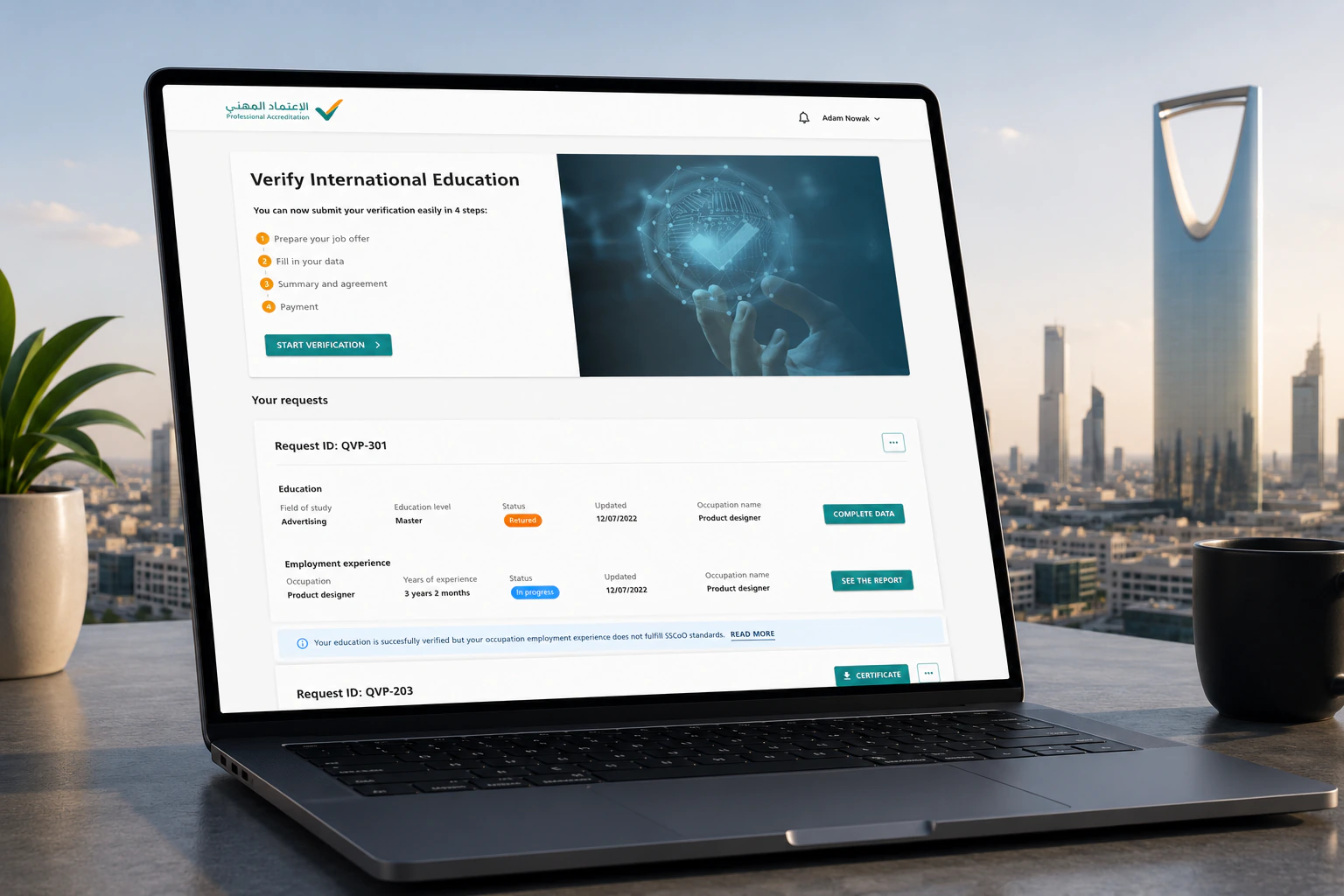
The Qualification Verification Platform (QVP) verifies the credentials of skilled expatriates, checking that their education and experience align with the level and field their occupation requires. It's part of the Professional Accreditation program run by the Saudi Ministry of Human Resources and Social Development, replacing a slow, offline process with a fully digital one.
The program supports Saudi Vision 2030, driving economic growth by raising the quality and productivity of the labor market.
Challenge
QVP already verified education, but a diploma doesn't prove someone can do the job. The ministry needed to verify real employment experience: where someone worked, for how long, and whether it met the standard for their occupation.
The hard part was scope: one feature touching candidate, verifier and admin, inside an existing rule-heavy flow, fully in right-to-left Arabic. My job was to make it feel guided, not overwhelming.
Goal
Replace a slow, offline accreditation process with a fully digital one that candidates can self-serve, protecting the integrity of the Saudi labor market and encoding the ministry's shifting verification standards correctly.
My role
As the sole designer on a scrum team, I owned the candidate, verifier and admin journeys – from business rules and IA through hi-fi UI, prototyping, testing and handoff.
How I approached it
01
Understand the rules
Worked with the ministry, PO and BA to define eligibility logic and changing requirements.
02
Map the hand-offs
Connected candidate, verifier and admin flows, including statuses and edge cases.
03
Design for guidance
Translated complex rules into clear steps, feedback and summaries in English and RTL Arabic.
04
Validate risky moments
Tested whether candidates understood requirements, missing information and their next action.
05
Ship and measure
Prepared the MVP and defined how adoption, completion, appeals and satisfaction would be measured.


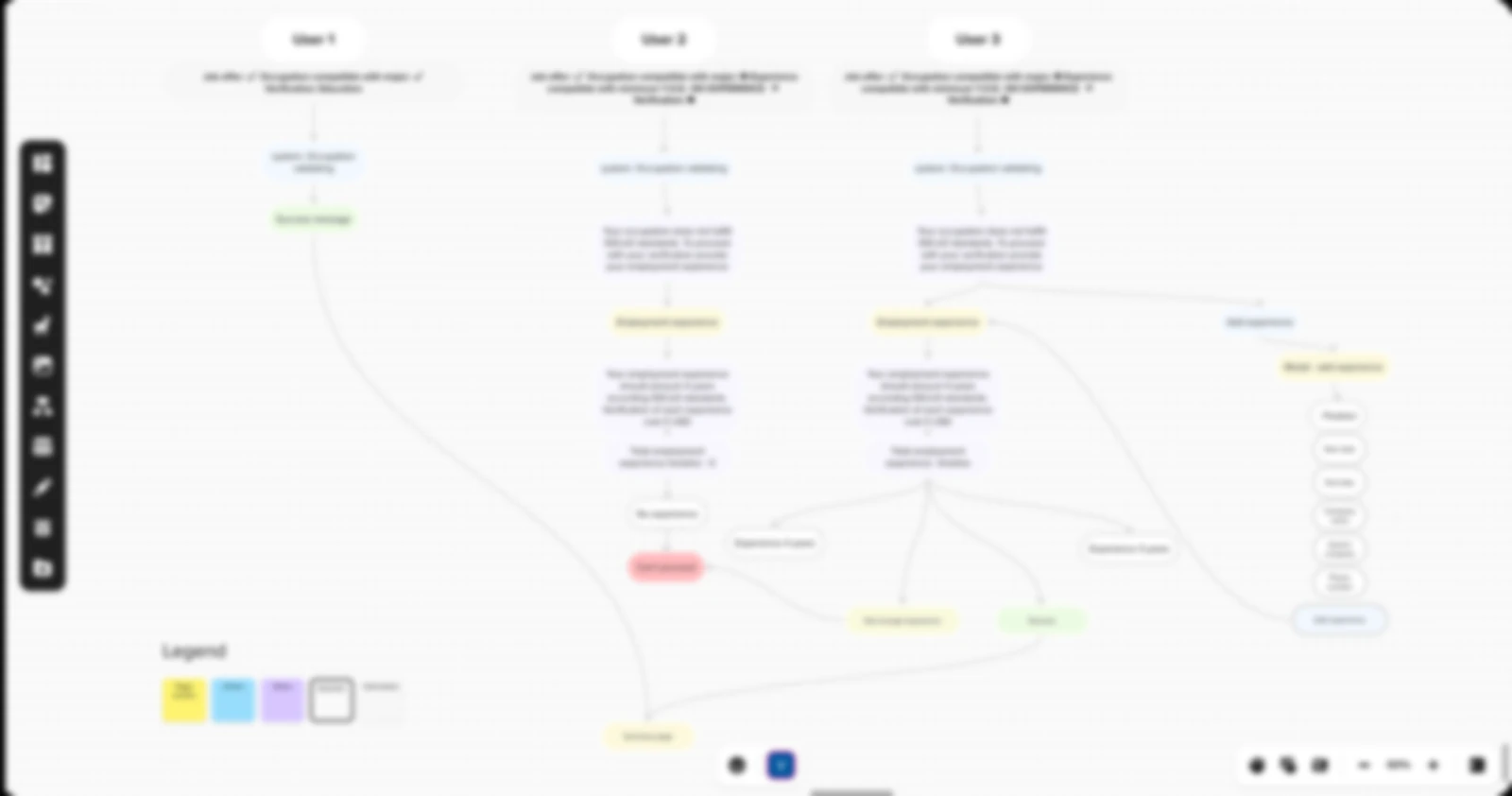
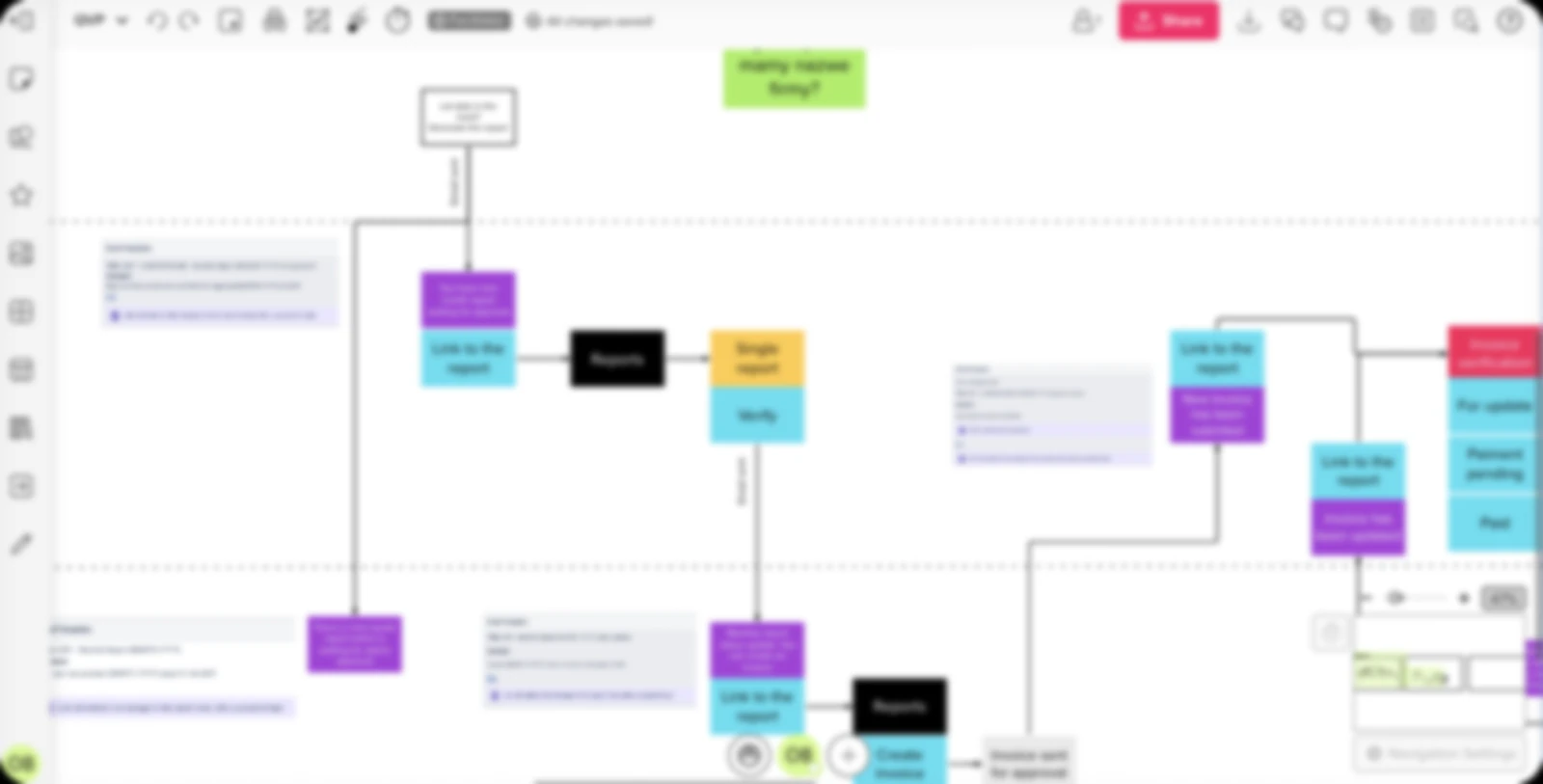
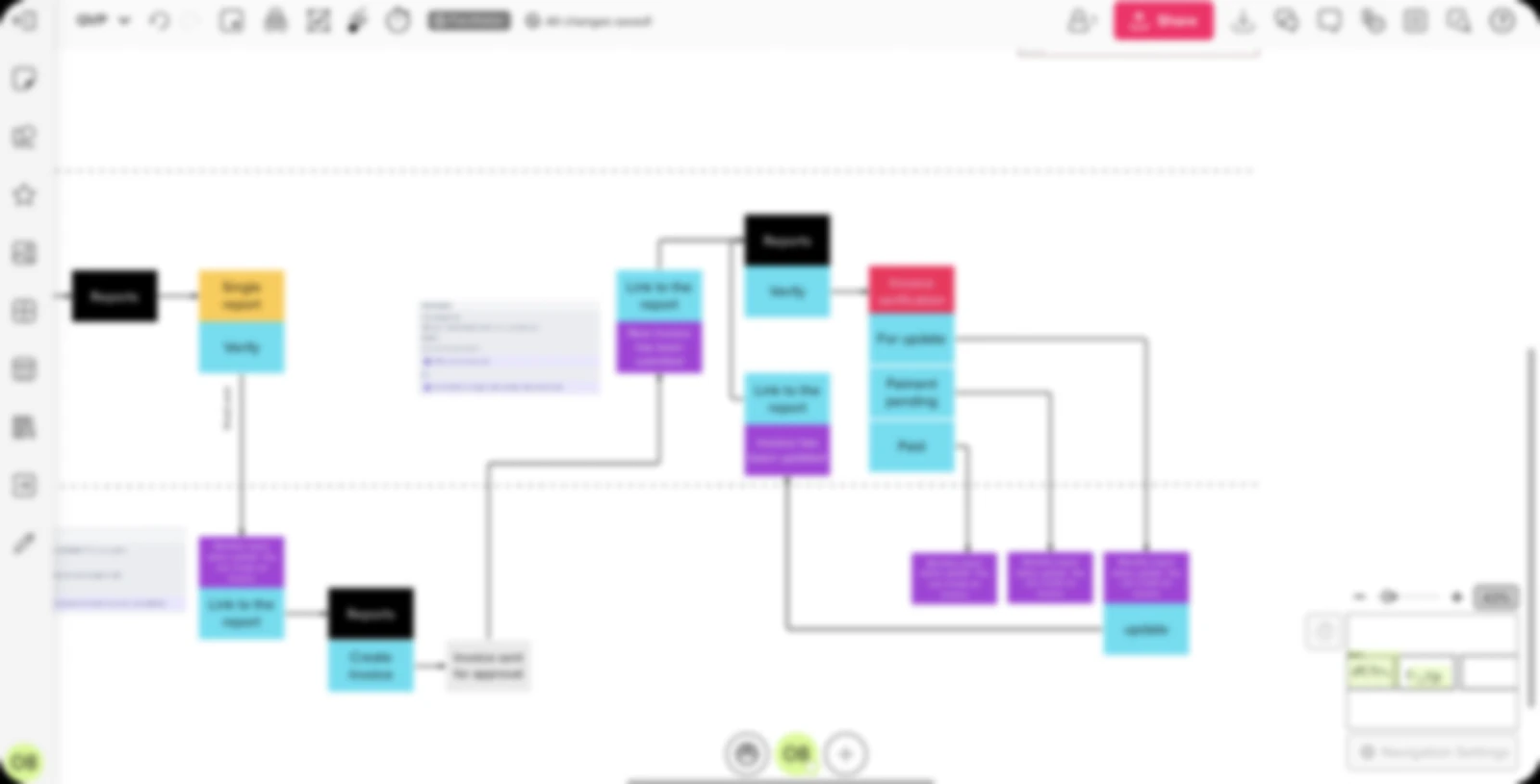
The maps connected candidate submissions, verifier decisions, admin oversight, status changes and exception paths across one system, blurred for confidentiality.
Candidates needed to document enough relevant employment history to meet the requirements of their occupation. I designed a guided flow that calculated total experience, surfaced missing information and helped candidates add supporting evidence without exposing the ministry's full rule set at once.
The same information then moved into the verifier workflow, where employment records, documents, statuses and follow-up requests could be reviewed in context.
A candidate's submission was only the first part of the workflow. Verifiers needed to review evidence, request corrections and record a decision. Admins needed visibility into statuses, reports and exceptions.
I designed the hand-offs so that each role saw the information and actions relevant to its part of the process, while the case remained consistent across the system.
Because the majority of my designs are confidential, I present only a small part of my work here.
Measurement plan
Before launch, I independently defined a measurement plan for QVP and presented it to the client, who approved the proposal. The metrics were designed to track adoption, completion effort, repeat use, appeals and satisfaction, and were later implemented in Metabase, Hotjar and Google Analytics.
Request funnel: users → drafts → submitted requests
Time to complete a request
Repeat requests per user
Appeal rate
Customer Satisfaction Score
The Outcome
The feature turned a slow, offline ministry process into a guided flow candidates could complete on their own, in both English and right-to-left Arabic.
Participants completed the core flow without encountering a critical usability issue.
Employment verification launched as part of QVP's platform release.
Candidates could complete a previously offline ministry process on their own.
Delivered end to end in English and right-to-left Arabic.
Reflection
The real work here wasn't making the screens look clean. It was deciding how much of a rule-heavy, high-stakes process to expose, and making everything else feel guided.
Prototyping exposed guidance gaps before development, when they were cheapest to fix. It helped us validate the flow before committing engineering time.
Sharing rough ideas early with the BA, PO and developers kept a rule-heavy flow aligned and shippable.